(CS-041) A Case Report ---Optimizing the wound bed in preparation for split thickness autograft coupling oxidized regenerated cellulose (ORC)/collagen silver dressings and negative pressure wound therapy.
Friday, April 28, 2023
7:15 PM - 8:30 PM East Coast USA Time
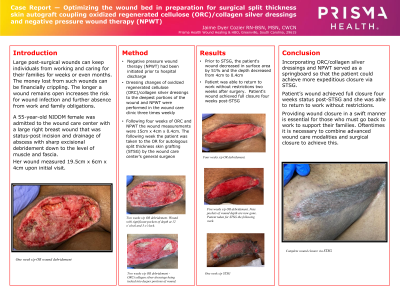
Introduction: Large post-surgical wounds can be challenging to heal. They can keep individuals from working or caring for their families for weeks to months and the money lost from such wounds can be financially crippling. The longer a wound remains open also increases the risk for wound infection and further absence from work and family obligations. We present a case in which a 55-year-old NIDDM female was admitted to the wound care center with a large right breast wound that was status-post incision and drainage of abscess with sharp excisional debridement down to the level of muscle and fascia. Upon the patient’s initial visit to the wound care center, her surgical wound measured 19.5cm x 6cm x 4cm.
Methods: Negative pressure wound therapy (NPWT) had been initiated prior to hospital discharge. Dressing changes of oxidized regenerated cellulose (ORC)/collagen silver dressings to the deepest portions of the wound and NPWT were initiated and completed in the wound care clinic three times weekly. Following four weeks of ORC and NPWT the wound measurements were 15cm x 4cm x 0.4cm. The same week the patient was taken to the OR for autologous split thickness skin grafting by the wound care center’s general surgeon.
Results: Prior to STSG, the patient's wound decreased in surface area by 51% and the depth decreased from 4cm to 0.4cm. Patient’s wound achieved full closure four weeks status post-STSG and she was able to return to work without restrictions two weeks after surgery.
Discussion: Incorporating ORC/collagen silver dressings and NPWT served as a springboard so that the patient could achieve more expeditious closure via STSG. Patient’s wound achieved full closure four weeks status post-STSG and she was able to return to work without restrictions. Providing wound closure in an expedited manner is essential for those who must go back to work to support their families. Oftentimes it is necessary to combine advanced wound care modalities and surgical closure to promote this.

.png)