(CS-055) New NPWT Standard for Treatment of Traumatic & Surgical Wounds
Friday, April 28, 2023
7:15 PM - 8:30 PM East Coast USA Time
Patrick Schwab, BS, MBA – Consultant, Consultant
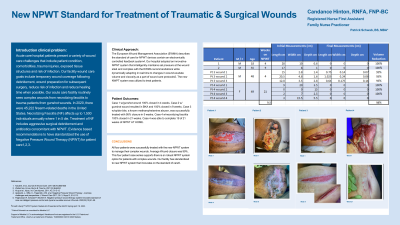
Introduction: Acute care hospital patients present a variety of wound care challenges that include patient condition, comorbidities, trauma injuries, exposed tissue structures and risk of infection. Our facility wound care goals include temporary wound coverage following debridement, wound preparation for subsequent surgery, reduce risk of infection and reduce healing time when possible. Our acute care facility routinely sees complex wounds from necrotizing fasciitis to trauma patients from gunshot wounds. In 2020, there were 45,222 firearm-related deaths in the United States. Necrotizing Fasciitis (NF) affects up to 1,500 individuals annually where 1 in 5 die. Treatment of NF includes aggressive surgical debridement and antibiotics concomitant with NPWT. Evidence based recommendations to have standardized the use of Negative Pressure Wound Therapy (NPWT) for patient care1,2,3.
Methods: The European Wound Management Association (EWMA) describes the standard of care for NPWT devices contain an electronically controlled feedback system4. Our hospital adopted an innovative NPWT system that intelligently maintains set pressure at the wound site4 and complies with the EWMA recommendations while dynamically adapting in real time to changes in wound exudate volume and viscosity as a part of wound care protocols5. The new NWPT system was utilized to treat patients.
Results: Case 1 w/gunshot wound 100% closed in 4 weeks. Case 2 w/gunshot wound resulted in BKA and 100% closed in 9 weeks. Case 3 w/spider bite, a known methamphetamine abuser, was successfully treated with 95% closure in 5 weeks. Case 4 w/necrotizing fasciitis 100% closed in 21 weeks. Case 4 was able to complete 19 of 21 weeks of NPWT AT HOME.
Discussion: All four patients were successfully treated with the new NPWT system to manage their complex wounds. Average Wound closure was 99%. This four patient case series supports there is an robust NPWT system option for patients with complex wounds. Our facility has standardized to new NPWT system that innovates on the standard of care5.

.png)