(CS-070) Dehydrated Human Amnion/Chorion Allograft Supports Limb Salvage Treatment of Infected First Metatarsophalangeal Joint Implant with Osteomyelitis
Friday, April 28, 2023
7:15 PM - 8:30 PM East Coast USA Time
Gabriel Cooper, DPM
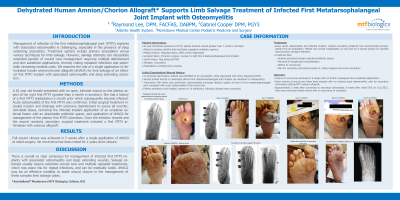
Introduction: Management of infection of the first metatarsophalangeal joint (MTPJ) implants with associated osteomyelitis is challenging, especially in the presence of deep extending ulcerations. Treatment options include primary amputation versus various techniques for limb salvage. However, salvage attempts can necessitate extended periods of wound care management requiring multiple debridement and skin substitute applications, thereby risking repeated infections and potentially increasing medical costs. We examine the role of a single application of dehydrated human amnion/chorion allograft (dHACA) for limb salvage of an infected first MTPJ implant with associated osteomyelitis and deep extending ulceration.
Methods: A 65 year old female presented with an open, infected wound on the plantar aspect of her right first MTPJ (greater than a month in duration). She had a history of a first MTPJ implantation a month prior which subsequently became infected. Acute osteomyelitis of the first MTPJ was confirmed. Initial surgical treatment included incision and drainage with extensive debridement to excise all necrotic, nonviable tissue, removing the infected implant application of an uniplanar external fixator with an absorbable antibiotic spacer, and application of dHACA for management of the plantar first MTPJ ulceration. Once the infection cleared and the wound resolved, secondary surgical treatment included a first MTPJ arthrodesis with cadaveric osseous allograft.
Results: Full wound closure was achieved in 5 weeks after a single application of dHACA at initial surgery. No recurrence has been noted for 2 years since closure.
Discussion: There is overall no clear consensus for management of infected first MTPJ implants with associated osteomyelitis and deep extending wounds. Salvage attempts usually require extended wound care and multiple repeated treatments, which may place risk for repeat infections, and can be medically costly. dHACA may be an effective modality to assist wound closure in the management of these complex limb salvage cases.

.png)