(CS-099) Retrospective Chart Review of Fetal Bovine Dermal Repair Scaffold in the Treatment of Chronic Wounds
Friday, April 28, 2023
7:15 PM - 8:30 PM East Coast USA Time
Amit Rao, M.D. – Project Manager, Surgery, Northwell Health Comprehensive Wound Healing & Hyperbaric Center; Sally Kaplan, R.N. – Research Nurse, Surgery, Northwell Health; Christina del Pin, M.D. – Attending Physician, Surgery, Northwell Health
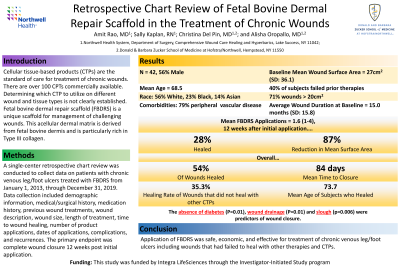
Introduction: Cellular tissue-based products (CPTs) are the standard of care for treatment of chronic wounds. There are over 100 CPTs commercially available. Determining which skin substitutes to utilize on different wound and tissue types is not clearly established. Fetal bovine dermal repair scaffold (FBDRS) is a unique scaffold for management of challenging wounds. This acellular dermal matrix is derived from fetal bovine dermis and is particularly rich in Type III collagen.
Methods: A single-center retrospective chart review was conducted to collect data on patients with chronic venous leg/foot ulcers treated with FBDRS from January 1, 2013, through December 31, 2019. Data collection included demographic information, medical/surgical history, medication history, previous wound treatments, wound description, wound size, length of treatment, time to wound healing, number of product applications, dates of applications, complications, and recurrences. The primary endpoint was complete wound closure 12 weeks post initial application.
Results: Among 42 subjects enrolled, mean age was 68.5 years, 56% were male, 54% were white, 23% were black, 14% were Asian, 23% had diabetes, 79% had peripheral vascular disease, and 40% had failed prior therapies. Baseline mean wound area was 27.0 cm2 (SD: 36.1) and 71% of wounds were > 20 cm2. Average wound duration at baseline was 15.0 months (SD: 15.8). Wounds received a mean 1.6 FBDRS applications (range: 1–4). At 12 weeks, 28% of wounds had closed and mean % area reduction was 87%. Overall, 54% of wounds healed and mean time to closure was 84 days (range: 28–327). The wound closure rate for wounds that had previously failed other skin substitutes was 35.3%. There were no wound infections, no amputations, and 1 (4%) wound recurrence. On average, subjects who healed were older (73.7 years [SD: 10.8]) than those who did not heal (62.6 years [SD: 17.5]) (P=0.02). Interestingly, when wound size is larger than 20cm2, the size of FBDRS used was found to be only 70% of the actual wound size, without compromising the overall closure rate (46.7%, n=17). The absence of diabetes (P=0.01), wound drainage (P=0.01) and slough (p=0.006) were predictors of wound closure.
Discussion: Application of FBDRS was safe, economic, and effective for treatment of chronic venous leg/foot ulcers including wounds that had failed to heal with other therapies and skin substitute products.

.png)