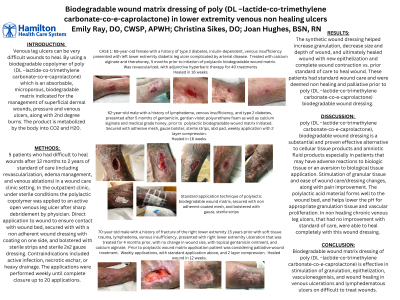
(CS-105) Abstract title: Biodegradable wound matrix dressing of poly (DL –lactide-co-trimethylene carbonate-co-e-caprolactone) in lower extremity venous and arterial non healing ulcers
Friday, April 28, 2023
7:15 PM - 8:30 PM East Coast USA Time
Joan Hughes, RN
Introduction: Venous and Arterial ulcers can be very difficult wounds to heal. By using a biodegradable copolymer of poly (DL –lactide-co-trimethylene carbonate-co-e-caprolactone) which is an absorbable, microporous, biodegradable matrix indicated for the management of superficial dermal wounds, pressure and venous ulcers, along with 2nd degree burns. The product is metabolized by the body into CO2 and H20.
Methods: 5 patients who had difficult to heal wounds after 12 months to 2 years of standard of care (including revascularization, edema management, and venous ablations) in a wound care clinic setting. In the outpatient clinic, under sterile conditions the polylactic copolymer was applied to an active open venous leg ulcer after sharp debridement by physician. Direct application to wound to ensure contact with wound bed, secured with with a non adherent wound dressing with coating on one side, and bolstered with sterile strips and sterile 2x2 gauze dressing. Contraindications included active infection, necrotic eschar, or heavy drainage. The applications were performed weekly until complete closure.
Results: The synthetic wound dressing helped increase granulation, decrease size and depth of wound, and ultimately healed wound with new epithelization and complete wound contraction vs. prior standard of care to heal wound. These were palliative wounds prior to treatment with poly (DL –lactide-co-trimethylene carbonate-co-e-caprolactone) biodegradable wound dressing.
Discussion: poly (DL –lactide-co-trimethylene carbonate-co-e-caprolactone), biodegradable wound dressing is a substantial and proven effective alternative to cellular tissue products and those who may have adverse reactions to biologic tissue or an aversion to biological tissue application. The polylactic acid material conforms well to the wound bed, and helps lower the pH, to provide an optimal environment to stimulate granulation tissue and vascular proliferation which allowed complete epithelialization and healing of these difficult non healing venous ulcers.

.png)