(CS-114) Novel technique to overcome challenges associated with management of difficult perineal pediatric wounds using a Transforming Powder Dressing: Case Series
Friday, April 28, 2023
7:15 PM - 8:30 PM East Coast USA Time
Mark Chaet, MD
Introduction: On average, 3.9 million pediatric surgeries are performed annually in the USA.1Five percent of surgical wounds develop infections or other wound complications, resulting in poor wound healing, and increased pain, hospital stay and treatment costs.2 Postoperative care, including adequate wound management, is critical to ensuring successful outcomes.3
Methods: This pediatric case series involves 3 patients with difficult-to-dress perineal wounds which were converted to a novel Transforming Powder Dressing (TPD). We hypothesized that the addition of TPD would facilitate wound closure and reduce primary dressing changes.
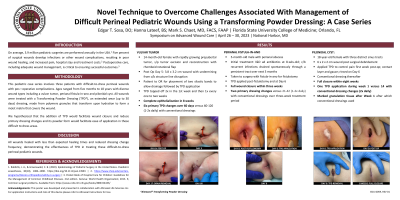
Vulvar Tumor: 14-month-old female with rapidly growing prepubertal tumor, s/p tumor excision and reconstruction with rhomboid rotational flap. Post op course c/b suture line disruption on post-op Day 5, resulting in 3.8 x 3.2 cm wound with undermining. Patient to OR for placement of two silastic bands to allow drainage followed by TPD application. TPD topped-off every 3-4 days the first week and then once every 1-2 weeks.
Perianal fistula-in-ano: 5-month-old male with perianal abscess. Initially treated with I&D and antibiotics at 8-weeks old, c/b recurrent infections drained spontaneously through a persistent tract over next 3 months. Taken to surgery with fistula-in-ano requiring fistulotomy. TPD applied post-fistulotomy and re-applied at Day 6.Pilonidal Cyst: 18-year-old female with pilonidal cyst (3 distinct sinus tracts), surgically unroofed and debrided resulting in 6 cm x 2 cm x 2 cm painful wound. Packed with TPD to control pain first week post-op; secured with contact layer and gauze, rinsed on Day 6 and conventional dressings applied twice daily thereafter.
Pilonidal Cyst: 18-year-old female with pilonidal cyst (3 distinct sinus tracts), surgically unroofed and debrided resulting in 6 cm x 2 cm x 2 cm painful wound. Packed with TPD to control pain first week post-op; secured with contact layer and gauze, rinsed on Day 6 and conventional dressings applied twice daily thereafter.
Results: Vulvar Tumor: Complete epithelialization in 8 weeks; 6 primary TPD changes versus 112 (2x daily) with conventional dressings.
Perianal fistula-in-ano: Full closure achieved within 3 weeks with 2 primary changes versus 56 (2x daily) with conventional dressings.
Pilonidal Cyst: Full closure within 8 weeks. One TPD application (versus 14 with conventional dressings) during first week. Marked granulation tissue proliferation was observed after Week 1 and conventional dressings were used thereafter.
Discussion: All wounds healed with less than expected healing times and limited dressing changes, demonstrating the effectiveness of TPD in treating difficult-to-dress perineal pediatric wounds.

.png)