(CS-144) Fish Skin Grafts (FSG) for the treatment of refractory and recalcitrant stage 3 Hidradenitis Suppurativa (HAS)
Friday, April 28, 2023
7:15 PM - 8:30 PM East Coast USA Time
Introduction: Hidradenits suppurativa is a well known skin condition marked by painful acne type appearing boils that develop both within the skin as well as some that can be located deep under the layers of the skin. HAS develops in the sweat (apocrine) glands. HAS develops when hairs become trapped within the hair follicles, leading to inflammation deep in the skin. Bacteria may also get trapped in the follicles, leading to recurrent infections. As the lesions grow, they can become painful and eventually rupture externally.
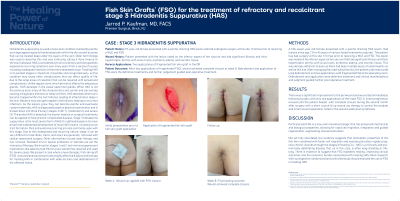
Methods: A fifty seven-year-old female presented with a painful draining HAS lesion. Had lesions since age 13 for 45 years of various failed treatments required . The patient has had surgery at this site 13 times prior to receiving a WLE and FSG. The lesion was noted on the inferior aspect of her sacrum that had significant fibrosis and thick hypertrophic dermis with sinus tracts, erythema, edema, and necrotic tissue. This was densely adherent to bone as there had been multiple bouts of osteomyelitis as well at this site. After managing the underlying infection, the patient underwent wide local debridement and two applications with fragmented FSG in the operating room. Debridement and application were definitive treatment and clinical manifestations and judgment guided further post operative treatment.
Results: There was a significant improvement to the periwound and wound bed immediately following surgery with only two applications of the intact FSG. A linear progression ensued until the patient healed with complete closure during the second month after surgery with a short course of np wound vac therapy to control the exudate and small wound separation noted in the second week post op (photos).
Discussion: Particularized FSG is a new and innovative biologic that has preserved mechanical and biological properties, allowing for rapid cell migration, integration and guided regeneration, augmenting neovascularization.
Not yet fully elucidated, but evidence suggests that hemostatic properties of the fish skin combined with faster cell migration and neovascularization rapidly progress chronic wounds through the stages of healing 3,4. HAS is a clinically and economically debilitating disease that, as in this case, is often long-standing or lifelong. There is evidence to suggest that FSG expedites healing, improving clinical outcomes and the economic burden associated with treating HAS. More research with a prospective randomized and controlled study should evaluate the use of FSG in treating HAS.

.png)