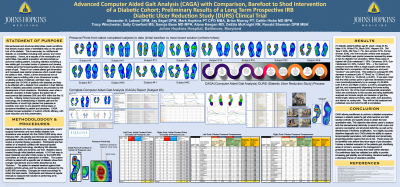
(CS-148) Advanced Computer Aided Gait Analysis (CAGA) with Comparison, Barefoot to Shod Intervention of a Diabetic Cohort; Preliminary Results of a Long Term Prospective IRB Diabetic Ulcer Reduction Study (DURS) Clinical Trial.
Friday, April 28, 2023
7:15 PM - 8:30 PM East Coast USA Time
Sanuja Bose, MD, MPH; Sally Crawford, n/a; Caitlin Hicks, MD MPH; Mark Hopkins, PT CPO MBA; Alana Keegan, MD; Brian Murray, PT; Jay Segal, DPM; Ronald Sherman, DPM MBA; Tracy Winchester, n/a
Introduction: The recognition of biomechanical and structural deformities create conditions that in turn progress to areas of identifiable risks on the plantar foot of the diabetic. These in turn create altered gait kinematics and increased peak plantar pressures which overall impair the ability to heal secondary to multifactorial diabetic co-morbidities including both sensory and motor neuropathy. Utilizing CAGA technology, the understanding of diabetic gait and the identification of occult high plantar foot pressures is possible, even prior to any apparent clinical signs or symptoms identified by patient and physician. CAGA enables focused evaluation of custom orthotic efficacy, with ulcer reduction and limb preservation.
Methods: Diabetic patients who have undergone conservative and/or surgical intervention and have healed diabetic foot ulcerations were entered into the study since February 2021. All patients receive a physical therapy evaluation. Participants are walked on a treadmill outfitted with temporal-spatial pressure sensing technology, identifying 255 discrete parameters, static and dynamic, per foot. Baseline was created through barefoot analysis. A 3D foot scan was taken bilaterally and after CAGA review, orthotic prescription was written. The custom orthotic was paired with a specific pair of diabetic shoes from a single manufacturer and is herein described as the “Solution”.
Results: 27 diabetic patients [Mean age 61 years- range 34-84, Male: 81%, White 67%, Black 30%, Hispanic 3%. DM Type 2: 93%, DM Type 1: 7%, Non-smoker: 67%, Former smoker: 33%], who met inclusion criteria were analyzed. CAGA identified peak plantar pressures representing areas at risk for diabetic foot ulceration. Within these areas of highest risk (Submetatarsal 1: 33%, Heel: 24%, Submetatarsals 3,4: 20%, Cuboid: 13%,…), the maximum pressure recorded within a single square centimeter was identified and a comparison of this area pre- and post-“solution” was performed. This yielded an average 64.83% decrease in pressure (Right: 45.0nm2 vs. 13.2nm2 and Left: 46.1nm2 vs. 13.4nm2. p< 0.001). Six of the most consequential parameters which are contributory to this success are being statistically analyzed and include: length and deviation of gait line, stride length, lateral symmetry, step width, foot abduction, and stance vs. swing ratio.
Discussion: CAGA allows practitioners to perform a comparison and obtain the best objective quantitative data to analyze biomechanical and structural deformity. It yields an evaluation of the patients gait, identifying areas of concern, success in the management of problematic areas, and areas that need further attention, leading to a decrease chance of ulceration potential.

.png)