(DLS-002) Perioperative Complications and Risk Factors in Surgery for Diabetic Foot Patients
Friday, April 28, 2023
7:15 PM - 8:30 PM East Coast USA Time
wen Lai, MD – chief doctor, Department of Burn and Wound Repair, Guangdong Provincial People's Hospital; hanhua Li, MD – attending doctor, Department of Burn and Wound Repair, Guangdong Provincial People's Hospital; Hongmin Luo, MD – attending doctor, Department of Burn and Wound Repair, Guangdong Provincial People's Hospital; lianghua Ma, MD – attending doctor, Department of Burn and Wound Repair, Guangdong Provincial People's Hospital; chuanwei Sun, MD – attending doctor, Department of Burn and Wound Repair, Guangdong Provincial People's Hospital
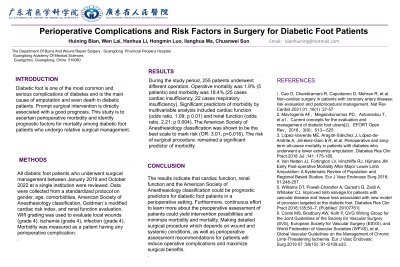
Introduction: Diabetic foot is one of the most common and serious complications of diabetes, and is the main cause of amputation and even death in diabetic patients. Prompt surgical intervention is directly associated with a good prognosis. This study is to ascertain perioperative morbidity and identify prognostic factors for mortality among diabetic foot patients who undergo relative surgical management.
Methods: All diabetic foot patients who underwent surgical management between January 2019 and October 2022 at a single institution were reviewed. Data were collected from a standardized protocol on gender, age, comorbidities, American Society of Anesthesiology classification, Goldman´s modified cardiac risk index, and renal function evaluation. WIfI grading was used to evaluate local wounds (grade 4), ischemia (grade 4), infection (grade 4), Morbidity was measured as a patient having any perioperative complication.
Results: During the study period, 255 patients underwent different operation. Operative mortality was 1.9% (5 patients) and morbidity was 18.4% (25 cases cardiac insufficiency, 22 cases respiratory insufficiency). Significant predictors of morbidity by multivariable analysis included cardiac function (odds ratio, 1.09; p 0.01) and renal function (odds ratio, 2.21; p 0.004). The American Society of Anesthesiology classification was shown to be the best scale to mark risk (OR: 3.01; p=0.016). The risk of surgical procedure. remained a significant predictor of morbidity.
Discussion: The results indicate that cardiac function, renal function and the American Society of Anesthesiology classification could be prognostic predictors for diabetic foot patients in a perioperative setting. Furthermore, continuous effort to learn more about the preoperative assessment of patients could yield intervention possibilities and minimize morbidity and mortality. Making detailed surgical procedure which depends on wound and systemic conditions, as well as perioperative assessment recommendations for patients will reduce operative complications and maximize surgical benefits.

.png)