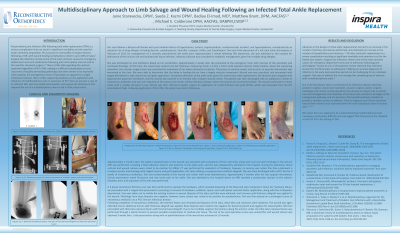
Introduction: Peri-prosthetic joint infection (PJI) following total ankle replacement (TAR) is a serious complication that can result in significant morbidity and possible lower extremity amputation. PJI accounts for nearly 80% of implant failures following a TAR, with wound healing complications in up to 40% of cases. There is little data regarding the optimal treatment of PJI in TAR, making it a difficult complication to treat. Here we present a case of an infected TAR, with associated osteomyelitis and surgical dehiscence, that required the use of a multidisciplinary team to aid in limb preservation.
Methods: Our case follows a 68-year-old female with past medical history of hypertension, asthma, hypothyroidism, cerebrovascular accident, and hyperlipidemia, who underwent placement of a TAR. The incision site subsequently dehisced, resulting in an ulceration that extended to the level of tendon. The patient underwent surgical debridement with bilayered skin substitute application. Additionally, the patient was referred to plastic surgery for application of a split thickness skin graft. Worsening ulceration was noted, and advanced imaging was performed, noting an abscess and loosening of hardware. The TAR was then removed and an antibiotic spacer was applied, along with stabilization using external fixation. Bone biopsy of the talus was positive for microbial growth, and the patient was placed on long term antibiotics by the infectious disease team.
Upon completion of the antibiotics and improvement of the ulceration, the external fixator was removed and repeat bone biopsies were performed. Negative biopsy results were obtained, and the antibiotic spacer was removed. Limb preservation consisting of tibio-talo-calcaneal fusion and femoral head allograft application was performed. Final wound closure was achieved using human bioactive split thickness allograft.
Results: Limb preservation along with re-epithelialization of the wound was achieved at 10 months. Time to diagnosis and clinical outcomes have been shown to improve with a multidisciplinary team approach.
Discussion: Treatment of infected TARs can be a difficult and tedious process, with few revisional options available. This case details the importance of a multidisciplinary approach to expedite the healing process in the setting of PJI following TAR.

.png)