(CS-121) New NPWT Standard for Management of the Open Abdomen
Friday, April 28, 2023
7:15 PM - 8:30 PM East Coast USA Time
Candance Hinton, RNFA, FNP-BC – Trauma Surgeon, Trauma Acute Care Surgery, Forrest General Hospital; Patrick Schwab, BS, MBA – Consultant, Medela
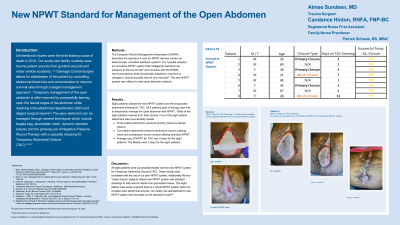
Introduction: Unintentional injuries were the third leading cause of death in 2019. Our acute care facility routinely sees trauma patient wounds from gunshot wounds and motor vehicle accidents.1,2 Damage Control Surgery allows for stabilization of the patient by controlling abdominal blood loss and contamination to improve survival rates through a staged management approach1. Temporary management of the open abdomen is often required by purposefully leaving open the fascial edges of the abdomen while resolving Intra-abdominal Hypertension (IAH) and staged surgical repairs2. The open abdomen can be managed through several techniques which include bogata bag, absorbable mesh, dynamic retention sutures and the growing use of Negative Pressure Wound Therapy with a specialty dressing for Temporary Abdominal Closure (TAC).4,5,6,7
Methods: The European Wound Management Association (EWMA) describes the standard of care for NPWT devices contain an electronically controlled feedback system8. Our hospital adopted an innovative NPWT system that intelligently maintains set pressure at the wound site4 and complies with the EWMA recommendations while dynamically adapting in real time to changes in wound exudate volume and viscosity9. The new NWPT system was utilized to treat open abdomen patients.
Results: Eight patients utilized the new NPWT system and the associated abdominal dressing for TAC. All 8 patients goal of therapy was met to temporarily manage the open abdomen with NPWT. Three of the eight patients expired from their injuries. Five of the eight patient abdomens were successfully closed.
< ! · Three patient abdomens received primary (fascia to fascia) c!osure. ·Two patient abdomens received abdominal closure utilizing mesh and subsequent wound closure utilizing standard NPWT.
Average use of NWPT for TAC was 4 days for the eight patients. The Median was 3 days for the eight patients.
Discussion: All eight patients were successfully treated with the new NPWT system for Temporary Abdominal Closure (TAC). These results were consistent with the use of our prior NPWT system. Additionally the two “mesh closure” patients utilized new NPWT system with standard dressings to help wound closure from granulation tissue. This eight patient case series supports there is a robust NPWT system option for complex open abdominal wounds. Our facility has standardized to new NPWT system that innovates on the standard of care8,9.

.png)