(CS-133) Treatment of hard to heal Venous Leg Ulcers with Fish Skin Graft in Geriatric Patients
Friday, April 28, 2023
7:15 PM - 8:30 PM East Coast USA Time
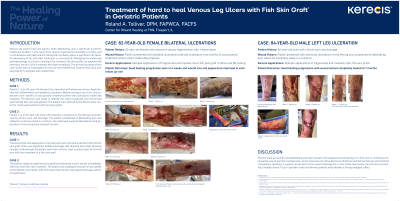
Introduction: Venous leg ulcers (VLU) are painful, often debilitating, and a significant economic healthcare burden1. VLUs result from venous hypertension secondary to reflux and in combination with obstruction2. Along with morbidity, age is a significant risk factor for developing VLUs, and often treatment is unsuccessful. Managing the underlying pathophysiology is critical to healing VLUs; however, fish skin grafts can augment the healing of chronic VLUs in patients with high morbidity3. The primary purpose of this case series was to investigate fish skin for the treatment of hard-to-heal VLUs and, secondarily, to evaluate pain subjectively.
Methods: Case 1:
Patient 1 is an 82-year-old female that presented with extensive venous hypertension with inflammation and bilateral ulcerations. Before coming to our clinic, she underwent nine months of unsuccessful treatment where the ulcerations made little progress. The decision was made to debride the ulcers surgically, and micronized and meshed fish skin was applied. The patient was referred to the Wound Care center for continued treatment with fish skin grafts.
Case 2:
Patient 2 is an 84-year-old-male with extensive ulcerations to the left leg accompanied by chronic pain and drainage. The patient complained of debilitating pain and stated he could only sleep in a recliner. He underwent surgical debridement and application of micronized and meshed fish skin.
Results: Case 1:
The wound size and appearance improved with each visit and treatment with the fish skin graft. There was significant bilateral drainage that required twice daily dressing changes. Interestingly, the patient went from chronic, near-constant pain to minimal pain with the treatment of a fish skin graft.
Case 2:
The patient stated he experienced a significant decrease in pain almost immediately after the initial fish skin treatment. The patient has undergone several fish skin grafts at the Wound Care Center with continued improvement, decreased drainage, and diminished pain.
Discussion: Chronic VLUs are painful and debilitating and often present with delayed wound healing1,2,3. Fish skin is minimally processed by way of osmotic mechanisms, which preserves its native dermal architecture and biomechanical and chemical composition resulting in superior acute and chronic wound healing4,5,6. In this small case series, the fish skin successfully treated chronic VLUs in geriatric male and female patients and provided a strong analgesic effect.

.png)