(CS-106) Successful Management of a Recalcitrant Venous Leg Ulcer with a Novel Proprietary Synthetic Self-Assembling Peptide Matrix - A Case Report
Friday, April 28, 2023
7:15 PM - 8:30 PM East Coast USA Time
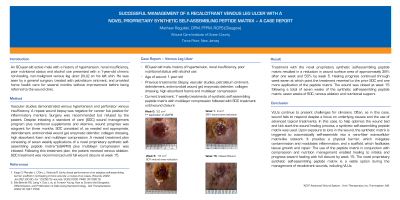
Introduction: An 80-year-old active male with a history of hypertension, renal insufficiency, poor nutritional status and alcohol use presented with a 1-year-old chronic non-healing, non-malignant venous leg ulcer (VLU) on his left shin. He was seen by a general surgeon, treated with petrolatum ointment, and provided home health care for several months without improvement before being referred to the wound clinic.
Methods: Vascular studies demonstrated venous hypertension and perforator venous insufficiency. A repeat wound biopsy was negative for cancer but positive for inflammatory markers. Surgery was recommended but refused by the patient. Despite initiating a standard of care (SOC) wound management program plus nutritional supplements and vitamins, wound progress was stagnant for three months. SOC consisted of, as needed and appropriate, debridement, antimicrobial wound gel, enzymatic debrider, collagen dressing, high absorbent foam and multilayer compression. A revised treatment plan consisting of seven weekly applications of a novel proprietary synthetic self-assembling peptide matrix* plus multilayer compression was initiated, after which the patient received venous ablation. SOC was recommenced until full wound closure at week 15.
Results: Treatment with the novel proprietary synthetic self-assembling peptide matrix resulted in a reduction in wound surface area of approximately 20% after one week and 65% by day 36. Healing progress continued through week seven at which point the treatment reverted to the prior SOC and one more application of the peptide matrix. The wound was closed at week 15 following a total of eight weeks of the synthetic self-assembling peptide matrix, six weeks of SOC, venous ablation and nutritional support.
Discussion: VLUs continue to present challenges for clinicians. Often, as in this case, wound fails to respond despite a focus on underlying causes and the use of advanced topical treatments. To help optimize the wound bed and kick start the wound healing process, a synthetic self-assembling peptide matrix was used. Upon exposure to ions in the wound, the synthetic matrix is triggered to automatically self-assemble into a nano-fiber extracellular matrix-like network. It provides a physical barrier, which mitigates contamination and modulates inflammation, and a scaffold, which facilitates tissue growth and repair. The use of the peptide matrix in conjunction with compression and nutrition management enabled healing to initiate and progress toward healing with full closure by week 15. The novel proprietary synthetic self-assembling peptide matrix is a viable option during the management of recalcitrant wounds, including VLUs.

.png)