(DLS-015) Surgical Management of Complex Limb Salvage with Ovine Forestomach Matrix
Friday, April 28, 2023
7:15 PM - 8:30 PM East Coast USA Time
Introduction: Chronic wounds that lead to major lower extremity amputation have immense consequences on quality of life, and ultimately, mortality[1]. Patients who are at higher risk of limb amputation often have multiple significant co-morbidities and complicated wound histories which can limit options for successful use of treatment modalities such as extracellular matrix (ECM) technologies [2]. Ovine forestomach matrix has been utilized in challenging chronic wounds for years [3,4,5]. This is a case evaluating the clinical safety and efficacy of OFM in surgical soft tissue reconstruction in multimorbid patients at significant risk of limb amputation who may otherwise be excluded from stringent inclusion/exclusion criteria of randomized controlled trials which rarely reflect the challenging patient population most likely to suffer from non-traumatic lower limb amputation.
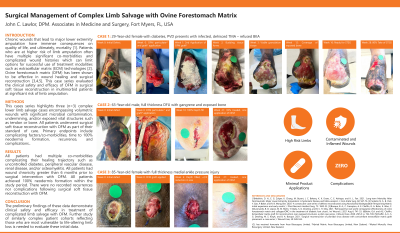
Methods: This cases series highlights three (n=3) complex lower limb salvage cases encompassing volumetric wounds with significant microbial contamination, undermining, and/or exposed vital structures such as tendon or bone. All patients underwent surgical soft tissue reconstruction with OFM (graft* and/or particulate^) as part of their standard of care. Primary endpoints include complicating factors/co-morbidities, time to 100% neodermis formation, recurrence, and complications.
Results: All patients achieved 100% neodermis formation within the study period. All patients had multiple co-morbidities complicating their healing trajectory such as uncontrolled diabetes, peripheral vascular disease, renal disease, and/or osteomyelitis. All patients had wound chronicity greater than 6 months prior to surgical intervention with OFM. There were no recorded recurrences nor complications following surgical soft tissue reconstruction with OFM.
Discussion: The preliminary findings of these data demonstrate clinical safety and efficacy in treatment of complicated limb salvage with OFM. Further study of similarly complex patient cohorts reflecting those who are most vulnerable to life-altering limb loss is needed to evaluate these initial data.

.png)