(CS-066) Total Contact Casting for Diabetic Foot Ulcerations in High-Risk Patients with Previous Partial Foot Amputation
Friday, April 28, 2023
7:15 PM - 8:30 PM East Coast USA Time
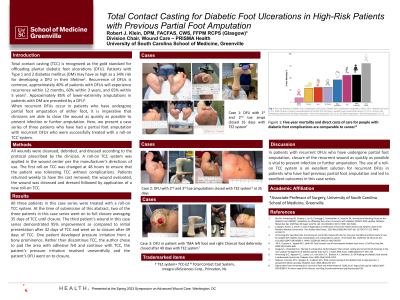
Introduction: Total contact casting (TCC) is recognized as the gold standard for offloading plantar diabetic foot ulcerations (DFU). Patients with Type 1 and 2 diabetes mellitus (DM) may have as high as a 34% risk for developing a DFU in their lifetime1. Recurrence of DFUs is common, approximately 40% of patients with DFUs will experience recurrence within 12 months, 60% within 3 years, and 65% within 5 years1. Approximately 85% of lower-extremity amputations in patients with DM are preceded by a DFU2.
When recurrent DFUs occur in patients who have undergone partial foot amputation of either foot, it is imperative that clinicians are able to close the wound as quickly as possible to prevent infection or further amputation. Here, we present a case series of three patients who have had a partial foot amputation with recurrent DFUs who were successfully treated with a roll-on TCC*system.
Methods: All wounds were cleansed, debrided, and dressed according to the protocol prescribed by the clinician. A roll-on TCC system was applied in the wound center per the manufacturer's directions of use. The first roll-on TCC was changed at 48 hours to ensure that the patient was tolerating TCC without complications. Patients returned weekly to have the cast removed, the wound evaluated, the wound was cleansed and dressed followed by application of a new roll-on TCC.
Results: All three patients in this case series were treated with a roll-on TCC system. At the time of submission of this abstract, two of the three patients in this case series went on to full closure averaging 35 days of TCC until closure. The third patient's wound in this case series demonstrated 95% improvement as compared to initial presentation after 42 days of TCC. One patient developed pressure irritation from a bony prominence. Rather than discontinue TCC, the author chose to pad the area with adhesive felt and continue with TCC, the patient's pressure irritation resolved uneventfully and the patient's DFU went on to closure.
Discussion: In patients with recurrent DFUs who have undergone partial foot amputation, closure of the recurrent wound as quickly as possible is vital to prevent infection or further amputation. The use of a roll-on TCC system is an excellent solution for recurrent DFUs in patients who have had previous partial foot amputation and led to excellent outcomes in this case series.

.png)