(CS-072) Prolonged Safe Vasodilation Medical Device* Warrants Further Clinical Evaluation As An Adjunctive Therapy For Wounds
Friday, April 28, 2023
7:15 PM - 8:30 PM East Coast USA Time
Introduction: Peripheral arterial disease (PAD) is a common cardiovascular complication in diabetics; prevalence increases with age and affects 30% of the aging population1,2. Patients with foot ulcers are more likely to present with PAD than those without ulcers2.In contrast to PAD in nondiabetics individuals, diabetics with peripheral neuropathy, are more likely to be asymptomatic. Patients with PAD and diabetes thus present later with more severe disease and have a greater risk of amputation which is associated with economic burden2,3. The economic costs of PAD exceed that of diabetes, coronary artery disease, and all cancers with most costs attributed to CLI4. Physical restoration of blood flow is necessary but is not always possible. In the setting of vascular insufficiency, healing is often stalled5. The use of adjunctive devices has been beneficial in improving wound outcomes6,7,8.
Methods: The human body’s physiological response to warmth is vasodilatation. Vasodilatation or widening of blood vessels, increases circulation or blood flow in the area warmed. A safe warmth device made of custom quilted nylon can be applied in a wrap fashion with hook and loop fasteners to a leg.
Participant wore shorts for 30 minutes to normalize skin temperature. Base line temperature was obtained with infrared thermometer and repeated at time intervals (20, 40, 60, 120, 180, 200 minutes) from baseline. The safe warmth device was worn bilaterally for 120 minutes. Temperature was then recorded for 2 more-time intervals. Tissue oximetry was utilized to capture regional tissue oxygenation before and after device use. Values were recorded for anatomical landmarks.
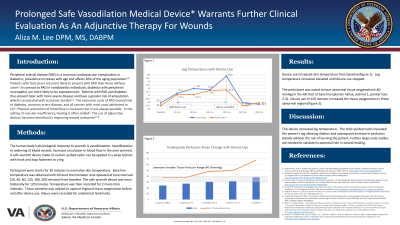
Results: Device use increased skin temperature from baseline. Leg temperature remained elevated until device use stopped. The participant was noted to have abnormal tissue oxygenation(< 40 mmHg) in the left foot at base line (plantar hallux, submet 1, plantar toes 2-4). Device use of 120 minutes increased the tissue oxygenation in these abnormal regions.
Discussion: This device increased leg temperature. The thick quilted nylon insulated the wearer’s leg allowing dilation and subsequent increase in perfusion distally without the risk of burning the patient. Further large-scale studies are needed to validate its potential role in wound healing.

.png)