(CS-003) Fish Skin Graft (FSG) for the treatment of post-Mohs wound of the nose
Friday, April 28, 2023
7:15 PM - 8:30 PM East Coast USA Time
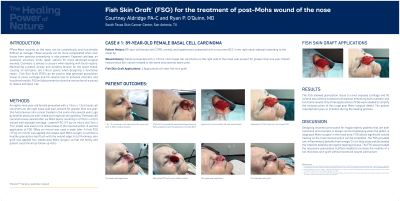
Introduction: Post-Mohs wounds on the nose can be cosmetically and functionally difficult to manage. These wounds can be more complicated when scar tissue from previous procedures is also present. Exposed cartilage, an avascular structure, limits repair options for more advanced surgical wounds. Cosmesis is always a concern when dealing with facial repairs. Maintaining a patent airway and avoiding tension on the lower eyelid, causing an ectropion, are critical points when designing a functional repair. Fish Skin Graft (FSG) can be used to help generate granulation tissue to cover cartilage and fill volume loss to enhance cosmetic and functional results. FSG will also prevent or slow the contraction of a wound to reduce ectropion risk.
Methods: An eighty-nine-year-old female presented with a 1.5cm x 1.3cm basal cell carcinoma on the right nasal side wall, present for greater than one year. She had previous skin cancer treated in the same area several years ago by another physician with visible scarring from skin grafting. The basal cell carcinoma was cleared after six Mohs layers resulting in a 5.0cm x 4.5cm wound with exposed cartilage. Layered FSG (19 sq cm micro and 3cm x 7cm sheet) was used in the initial phase of the reconstruction. A second application of FSG (38sq cm micro) was used a week later. A final FSG (19 sq cm micro) was applied two-weeks post Mohs surgery to achieve a healthy granulation bed flush with the wound edge. A full thickness skin graft was applied four weeks post Mohs surgery so that the family and patient could minimize follow up visits.
Results: The FSG allowed granulation tissue to cover exposed cartilage and fill volume loss without excessive contraction enhancing both cosmetic and functional results. Only three applications of FSG were needed to simplify the reconstruction of this large post Mohs surgical defect. The patient reported zero pain or irritation during the healing process.
Discussion: Designing reconstructive plans for fragile elderly patients that are both functional and cosmetic in design can be challenging when the defect is large post Mohs surgery in the nasal area. FSG allows significant wound healing so the final reconstruction can be simplified. The FGS provided anti-inflammatory benefits from omega-3-rich fatty acids and decreased the infection potential during the healing process. The FSG also provided the necessary granulation scaffold needed to increase the viability of a full thickness skin graft without excessive wound contracture.

.png)