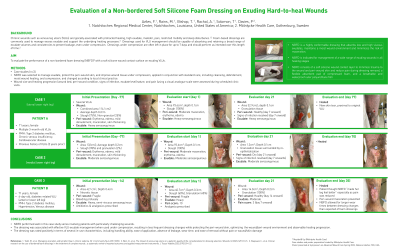
(CS-011) Evaluation of a Non-Bordered Soft Silicone Foam Dressing on Exuding Hard-To-Heal Wounds.
Friday, April 28, 2023
7:15 PM - 8:30 PM East Coast USA Time
Tracy Bishop, BSN, RN, CWS – Wound Care – NRMC; Terri Solomon, RN, WCC, OMS – Wound Care – NRMC; Mayghen Rains, RN, CWS – Wound Care – NRMC; Andrea Rachal, RN, WCC – Wound Care – NRMC; Viki Buras, RN – Wound Care – NRMC
Introduction: Chronic wounds such as venous leg ulcers (VLUs) and diabetes-related foot ulcers (DFUs) are typically associated with protracted healing, relatively high levels of exudation, malodour, pain, restricted mobility and sleep disturbance. Foam-based dressings are often used on VLUs and DFUs to manage excess exudate, whilst also supporting the underlying healing processes. It is important that dressings are able to manage a broad range of exudate volumes and consistencies) in order to prevent leakage which otherwise causes distress and embarrassment to patients. Dressings must be able to absorb and retain exudate when used under compression or off-loading devices. These devices are often left in place for periods of up to 7 days, hence dressings that can perform as intended over this length of time are desired.
A patient case study series was undertaken to evaluate the performance of a non-bordered foam dressing with a soft silicone wound contact surface on exuding VLUs and DFUs.
Methods: The dressing was applied in conjunction with standard care (i.e. including compression for VLUs and offloading for DFUs) and changed according to local clinical practice. At scheduled clinic visits, wound size and healing progression (wound tissue type, peri-wound condition, signs of infection, exudate level/nature).
Results: The dressing was associated with effective exudate management when used under compression and offloading devices, resulting in good wound healing progression and healthy peri-wound skin. SD was rated positively in terms of several in-use characteristics, including handling ability, ease of application, use under compression and off-loading systems, absence of leakage, wear time, and ease of removal without pain or wound/skin damage
Discussion: The dressing performed well in this case study series involving patients with particularly challenging wounds, contributing to the avoidance of moisture-related damage (maceration) and leakage, whilst also promoting a wound environment conducive to healing.

.png)