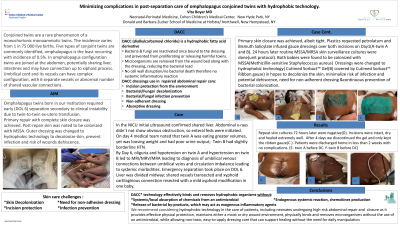
(CS-019) Minimizing complications in post-separation care of omphalopagus conjoined twins with hydrophobic technology.
Friday, April 28, 2023
7:15 PM - 8:30 PM East Coast USA Time
Introduction: Conjoined twins are a rare phenomenon. Five types are identified. In omphalopagus configuration twins are joined at the abdomen, potentially sharing liver, intestines and may have connection up to xiphoid process.
We present a case of preterm omphalopagus twins requiring early separation and repair secondary to clinical instability due to twin-to-twin ex-utero transfusion. Post-repair skin was noted to be colonized with Methicillin-Sensitive Staphylococcus Aureus(MSSA). Outer dressing was changed to hydrophobic technology to decolonize skin, prevent infection and risk of wounds dehiscence. Hydrophobic technology* (via dialkylcarbamoylchloride(DACC) coating) can support host’s wound environment by passively removing microbes through hydrophobic microbe binding, leading to bacterial inactivation, quiescence and decrease in systemic reaction of the host.
Methods: On day of life 4 Twin A was noted to continuously lose weight and had poor urine output; Twin B had borderline HTN. By Day 6, oliguria and hypotension on twin A and hypertension on twin B led to MRI/MRV/MRA leading to diagnosis of umbilical venous connections and circulation imbalance leading to systemic morbidities. Ex-utero twin-to-twin transfusion was diagnosed.
Emergency separation took place on DOL 6. Liver was divided midway; shared vessels transected and xyphoid cartilaginous connection resected. Primary skin closure was achieved. Plastics placed bismuth-petrolatum infused gauze dressings over both incisions. 24 hours later routine MSSA/MRSA skin surveillance cultures were done. Both babies were found to be colonized with MSSA.
Results: Dressings were changed to hydrophobic technology( Cutimed Sorbact™ Gel covered by Cutimed Sorbact™ Ribbon gauze). Repeat skin cultures 72 hours later were negative. Incisions were intact, dry and healed extremely well. After 4 days we discontinued the gel and only kept the ribbon gauze.
Patients were discharged home in less than 2 weeks with no complications.
Discussion: We recommend considering hydrophobic technology in the care of neonates undergoing high-risk abdominal repair as it maintains either a moist or dry wound environment, physically binds and removes microorganisms without the use of an antimicrobial, while allowing non-toxic, easy-to-apply dressing care that can support healing without the need for daily manipulation.

.png)