(CS-026) Venous leg ulcers treated with a novel Dual Component System (DCS), that combines short and long stretch layers, follow up results in an ambulatory care setting.
Friday, April 28, 2023
7:15 PM - 8:30 PM East Coast USA Time
Introduction:
Introduction:
A combination of long and short stretch bandages have been shown to be beneficial in Randomized Controlled Trials. However, there is merit in conducting and reporting on large real life patient cohorts outside of a controlled trial. We describe here the evolution of venous leg ulcers (VLU) treated with a novel Dual Component System (DCS) and followed up in the community. The Dual Component System has the unusual approach of combining a short and a long stretch bandage, where the fabrics in the two layers intercalate and provide the compressive performance without slippage.
Methods:
Methods: Clinical characteristics of patients with VLU for which DCS was prescribed were described. These patients were followed up by nurses using a secured electronic case record form on smartphone.
Results:
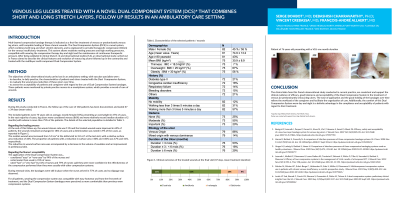
Results: 102 VLU patients (mean duration 68 days, recurring ulcer in 65%), venous etiology 86.1%, mixed 13.9% were followed post DCS treatment. VLU median area 5.0 cm² decreased to 2.0 cm² (p < 0.05), 60% reduction in 39 days. Median PUSH score decreased from 11 to 9 (p =0.05) and the percentage of high exudates decreased from 26.4% to 9.4% (p < 0.05). 94.0% of nurses found the DCS tested easy or very easy to use, 76.0% felt that it facilitated their nursing and 79.0% felt more confident in the effectiveness of the compression.
Discussion: Wearing this Dual Component Compression System (DCS) results in significant evolutions of ulcers towards healing while facilitating the task of nurses. Previous RCTs have shown ability of DCS to match performance with bulkier, 4 layer systems. Here, it is shown that under real life non RCT like conditions, the product is of value in the management of VLU on a diverse set of patients.

.png)