(CS-027) The Use of a Novel Autologous Multilayered Leukocyte, Platelet and Fibrin Patch in Healing Chronic Diabetic Foot Ulcers
Friday, April 28, 2023
7:15 PM - 8:30 PM East Coast USA Time
Bradley jimerson, DPM – Wound Center – Center for Orthopaedics; Kalieb Pourciau, DPM – Center for Orthopaedics; Cody Gaupel, DPM – Resident, Wound Center, Christus; Tyson Green, DPM – Center for Orthopaedics
Introduction: Diabetic foot ulcers are an overlooked epidemic in the United States with potentially serious results, such as amputation or ultimately death. It is estimated that 15-25% of patients with diabetes will develop a foot ulcer in their lifetime. These patients tend to see numerous specialists and undergo various treatments to heal their wounds. New interventions for treating diabetic foot ulcers continue to be developed. One novel technology recently introduced in the US is the use of an autologous multilayered leukocyte, platelet, and fibrin patch to heal patients with diabetes and chronic ulcers.
Methods: The study presents several patients who failed to progress in a timely repair sequence during conventional wound care despite weekly sharp debridement, local wound care, and offloading as indicated. Other advanced wound products had been tried and failed. All patients presented with type 2 diabetes. Investigators measured and analyzed wounds weekly.
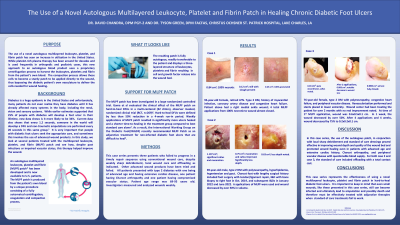
Results: One patient with Charcot foot deformity had a prolonged treatment history consisting of numerous hospitalizations, infections, and surgical debridements. Negative pressure wound therapy had also been utilized in an attempt to close the wound. Since the initiation of multilayered leukocyte, platelet and fibrin patch and offloading with the TCC, the wound size decreased from 7.65 cm3 to 0.001 cm3 in approximately five months and ten patch applications. Another patient had a retracted history of poor wound healing but since initiation of multilayered leukocyte, platelet and fibrin patch applications, the wound reduced in 0.646 cm3 to 0.135 cm3 in 14 weeks and 13 applications. A third patient, while not showing a significant decrease in size, has demonstrated an improvement in quality of granulation tissue.
Discussion: In this case series, the use of the autologous patch, in conjunction with local sharp debridement and appropriate offloading, contributed to significant improvement in not only the size of the wound but also the quality and integrity of the granulation tissue. These significant improvements enabled the patients to continue to heal their wounds and hopefully avoid potential future infections and amputations.

.png)