(CS-061) Novel Bioactive Glass Wound Matrix Promotes Healing in Hard-to-Heal Wounds of Geriatric Patients with Multiple Comorbidities
Friday, April 28, 2023
7:15 PM - 8:30 PM East Coast USA Time
David Armstrong, DPM, MD, PhD
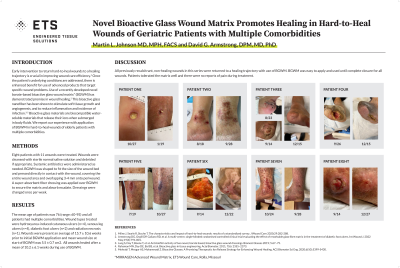
Introduction: Early intervention to return hard-to-heal wounds to a healing trajectory is crucial in improving wound care efficiency. Once the patient’s underlying conditions are addressed, there is enhanced benefit for use of advanced products that target specific wound problems. Use of a recently developed novel borate-based bioactive glass wound matrix* (BGWM) has demonstrated promise in wound healing. This bioactive glass nanofiber has been shown to stimulate soft tissue growth and angiogenesis, and to reduce inflammation and incidence of infection. Bioactive glass materials are biocompatible water-soluble materials that release their ions when submerged in body fluids. We report our experience with application of BGWM in hard-to-heal wounds of elderly patients with multiple comorbidities.
Methods: Eight patients with 11 wounds were treated. Wounds were cleansed with sterile normal saline solution and debrided if appropriate. Systemic antibiotics were administered as needed. BGWM was shaped to fit the size of the wound bed and pressed directly in contact with the wound, covering the entire wound area and overlapping 3-4 mm onto periwound. A super-absorbent fiber dressing was applied over BGWM to secure the matrix and absorb exudate. Dressings were changed once per week.
Results: The mean age of patients was 76 (range: 60-95) and all patients had multiple comorbidities. Wound types treated were hydroxyurea-induced cutaneous ulcers (n=4), venous leg ulcers (n=4), diabetic foot ulcers (n=2) and vasopressor-induced digital necrosis (n=1). Wounds were present an average of 15.7 ± 10.6 weeks prior to initial BGWM application and mean wound size at start of BGWM was 5.5 ± 0.7 cm2. All wounds healed after a mean of 10.2 ± 6.1 weeks during use of BGWM.
Discussion: All previously recalcitrant, non-healing wounds in this series were returned to a healing trajectory with use of BGWM. BGWM was easy to apply and used until complete closure for all wounds. Patients tolerated the matrix well and there were no reports of pain during treatment.

.png)