(CS-064) Real-World Treatment Scenarios of Complex Lower Extremity Wounds with a Human Keratin Hydrogel Matrix*
Friday, April 28, 2023
7:15 PM - 8:30 PM East Coast USA Time
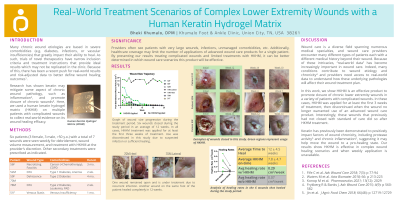
Introduction: Chronic lower extremity wounds are a complication of many conditions, including diabetes and vascular diseases, and can lead to amputations with a high future morbidity and mortality rates. Many treatments exist for such wounds. However, available product efficacy data is often from very limiting study designs that are not representative of the patients nor the ever-adapting methods found in the wound care clinic. In this case series, we sought to understand how a human keratin hydrogel matrix (HKHM)*, an advanced wound care product, would perform to close chronic wounds in a real-world wound care practice setting.
Methods: Six patients (3 female, 3 male, >50 yo) with a total of 7 chronic lower extremity wounds (confirmed by run-in period) were seen weekly for wound care including debridement, wound volume measurement, and treatment with HKHM* and appropriate secondary dressing at the provider’s discretion. Antibiotics and negative pressure wound therapy were prescribed as appropriate. Weekly follow-up was continued until complete wound closure.
Results: Four of the seven wounds achieved complete closure within 13 weeks of treatment with HKHM*. The provider treated wounds with HKHM* an average of 57 ± 16% of the weeks the wound was treated. This percentage was not different between wounds that did and did not heal by 13 weeks (p=0.2571 by Mann-Whitney test), and HKHM* was always applied weekly early in the wound treatment. The three wounds that took longer to close included the largest (17.28 cm^3) wound, most antibiotic treated (4 weeks) wound, and oldest patient (78M).
Discussion: This case series investigated the real-world usage of HKHM* to promote healing in chronic and complicated lower extremity wounds: diabetic ulcers, a venous stasis ulcer, and a chronic ulcer in a chemotherapy patient. While HKHM* was applied for more than half of the total wound care duration, it was often discontinued later on to allow the wound to finish closing on its own. This is supported by previous data suggesting HKHM* “jump starts” healing in chronic wounds, and shows HKHM* may still promote healing in cases where advanced wound care product applications are limited.

.png)