(CS-067) Use of Negative Pressure Wound Therapy With Instillation and Dwell Time in Non-Healing, Lower Extremity Wounds
Friday, April 28, 2023
7:15 PM - 8:30 PM East Coast USA Time
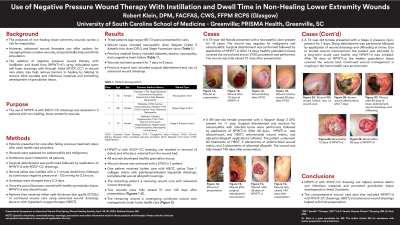
Introduction: Presence of non-healing lower extremity wounds carries a risk for amputation. However, advanced wound therapies can offer options for managing these complex wounds, and potentially help avoid limb amputation. The addition of negative pressure wound therapy with instillation and dwell time (NPWTi-d*) using reticulated open cell foam dressings with through holes (ROCF-CC†) to wound care plans may help remove barriers to healing by removing thick exudate and infectious materials along with promoting the development of granulation tissue. The use of NPWTi-d with ROCF-CC dressings was assessed in 3 patients with non-healing, lower extremity wounds.
Methods: Patients presented for care after failing previous treatment plans with other health care providers. Wounds were assessed for osteomyelitis and malignancy. Antibiotics were initiated for all patients. Surgical debridement was performed followed by application of NPWTi-d with ROCF-CC. Normal saline was instilled with a 1 minute dwell time, followed by negative pressure at -125 mmHg for 2.5 hours. Dressings were changed every 2-3 days. Once the wound bed was covered with healthy granulation tissue, NPWTi-d was discontinued. Two patients received split-thickness skin grafts. One patient received further wound care using advanced wound dressings and hyperbaric oxygen therapy (HBOT).
Results: Three patients (age range 66-73 years) presented for care. Wound types included neuropathic ulcer, Wagner Grade 3 diabetic foot ulcer, and a stage 4 pressure injury. Previous medical history included diabetes, obesity, neuropathy, and congestive heart failure. Wounds had been present for 7 days to 8 years. Previous wound care included debridement and advanced wound dressings. NPWTi-d with ROCF-CC use resulted in development of granulation tissue and removal of debris and infectious materials. Two patients underwent a skin graft procedure after NPWTi-d use. The remaining patient underwent further care with HBOT, native Type I collagen matrix with polyhexamethylene biguanide dressings and placental wound allograft coverings. All wounds were fully closed 51-140 days after presentation.
Discussion: NPWTi-d with ROCF-CC dressing use helped promote granulation tissue development and remove debris and infectious materials in these 3 patients. The comprehensive wound care plan that included NPWTi-d with ROCF-CC dressings, HBOT, and advanced wound dressings helped in limb preservation.

.png)