(CS-068) Case Study: Single application of acellular dermal matrix used as successful treatment of complex diabetic foot ulcers in multiple co-morbidity patient.
Friday, April 28, 2023
7:15 PM - 8:30 PM East Coast USA Time
Introduction: The treatment of diabetic foot ulcers, especially when additional comorbidities exist, remains a complex public health concern with both clinical and economic burden, requiring consistent assessment of technologies and modalities that could facilitate successful treatment.
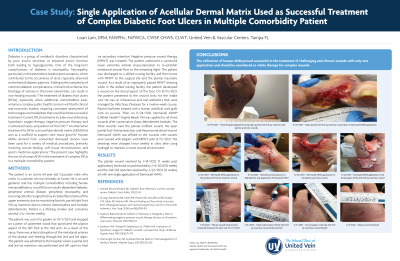
Methods: A 64 y/o Caucasian male, with multiple co-morbidities including HIV, NIDDM, PAD, peripheral neuropathy, previous necrotizing fasciitis, and chronic osteomyelitis, presented to clinic with complex non-healing wounds due to traumatic, arterial, and surgical complications. The patient had previously received multiple debridements, partial ray resections, lower extremity revascularization, and negative pressure wound therapy for multiple diabetic foot ulcers, however, his wounds remained unhealed. The patient also sustained a proximal dorsal foot wound due to improper placement of a NPWT dressing while being treated at a skilled nursing facility (SNF) post revascularization and surgical resection. The patient’s wounds were initially assessed and treated in clinic, 15 days post SNF complication. The patient, whose wounds remained unchanged, was treated 40 days post his first office visit with a single application of acellular dermal matrix (ADM)* to 3 wounds on the left foot – a) the traumatic plantar midfoot wound; b) the open partial 2nd ray/3rd ray resection; c) the more proximal dorsal foot wound. The ADM* was applied and sutured into place. A bolster dressing was applied with subsequent traditional moist wound and hydrogel dressing applications twice a week during in-office visits.
Results: The patient found full wound resolution of all wounds (plantar midfoot, surgical ray resection, and dorsal foot) at post application day 51 and 61, respectively.
Discussion: The utilization of ADM proved as a successful treatment of challenging and chronic wounds with only one application and should be considered as viable therapy for complex wounds.

.png)