(CS-075) Early Use of Negative Pressure Wound Therapy and Topical Solution Instillation in Complex Wounds of Patients With Vascular Disease
Friday, April 28, 2023
7:15 PM - 8:30 PM East Coast USA Time
Wendy Bowles, NP F, MSN
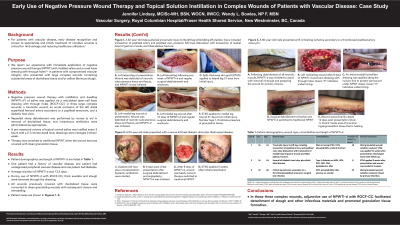
Introduction: For patients with vascular disease, early disease recognition and access to appropriate and timely treatment of complex wounds is critical for limb salvage and reducing healthcare utilization. We report our experience with immediate application of negative pressure wound therapy (NPWT) with instilled saline and a novel foam dressing with through holesin patients with compromised vascular integrity who presented with large complex wounds containing substantial areas of devitalized tissue and/or yellow fibrinous slough.
Methods: Negative pressure wound therapy with instillation and dwelling (NPWTi-d*) of saline was applied via a reticulated open-cell foam dressing with through holes (ROCF-CCƚ) in three large complex wounds: a traumatic wound, surgical site wound infection, and diabetic foot ulcer. Two patients had history of vascular disease and one patient sustained a traumatic vascular injury. Conservative bedside sharp wound debridement was performed by nurses, and intravenous antibiotics were administered as appropriate. A pre-measured volume of topical normal saline was instilled every 3 hours with a 2-3 minute dwell time; dressings were changed 3 times/week. Therapy was switched to conventional NPWT when wound bed was covered with clean granulation tissue.
Results: Average duration of NPWTi-d was 12.3 days. During use of NPWTi-d with ROCF-CC, thick exudate and slough were removed through the dressing. All wounds previously covered with devitalized tissue were converted to clean granulating wounds with subsequent closure and remodeling.
Discussion: In these three complex wounds, adjunctive use of NPWTi-d with ROCF-CC facilitated detachment of slough and other infectious materials and promoted granulation tissue formation.

.png)