(CS-076) The Application of Piscine Acellular Dermal Matrix (PADM) in surgical reconstruction and salvage
Friday, April 28, 2023
7:15 PM - 8:30 PM East Coast USA Time
Introduction: Surgical wounds are synonymous with traumatic wounds with regards to their tissue needs. Whatever the etiology; ischemia, frank trauma, metabolic, phlebolymphodema, amputation, the resulting wounds have common characteristics and demands that need to be met to regenerate tissue and heal. The resultant wound requirements need to be addressed, tissue defect, exposed structure, infection and contamination, diminished vascularity, disorganized cells, a paucity of cells, inflammation and pain.
Methods: Surgical Traumatic Wounds
Cases: 1.
2.
3.
4.
5.
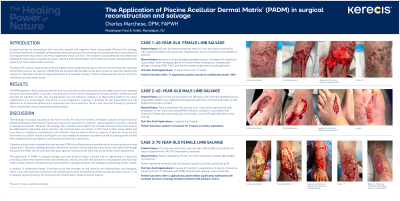
Results: The PADM applied in the cases presented has a macrostructure with a physically robust integrity that covers exposed structure and tissue deficit. It posses a microstructure that is more favorable then human amniotic membrane that provides for ingrowth of cells, neo vascularization and cell adhesion making it an ideal lattice platform for tissue replacement. It is immunogenic and elicits no host response or rejection. It provides for cell organization (via cell adhesion on its favorable lattice) and it possesses the macromolecules, factors, and cells that through its paracrine effect orchestrates tissue replacement and formation.
Discussion: The ethology of surgical wounds can be; frank trauma, the result of ischemia, metabolic disease, the poor tissue of phlebolymphodema that leads to tissue loss, post amputation wounds or wounds of salvage procedures. Whatever the etiology, the resultant tissue defect has complex characteristics that need to be addressed to regenerate tissue and heal.
The extracellular matrix is essential to heal wounds. ECM bio scaffolds play an essential role in tissue reconstruction and replacement. These bio scaffolds provide a lattice that maintain macromolecules, tissue factors and cells that through the paracrine effect recruit, communicate and organize necessary host cells that will promote tissue replacement.

.png)