(CS-080) A Novel Surgical Approach in Treating Moderate to Severe Hallux Rigidus with Combined Cheilectomy, Lapidus Arthrodesis, and Intra-articular Dehydrated Human Umbilical Cord Allograft.
Friday, April 28, 2023
7:15 PM - 8:30 PM East Coast USA Time
Jake Michaelson, Director – Director, Clinical & Scientific Liasion, MIMEDX Group, Inc.; William Tettelbach, MD, FACP, FIDSA, FUHM, FAPWCA, CWSP – Executive Medical Director Wound & Hyperbaric Medicine Service Line/Adjunct Assistant Professor, HCA Healthcare/Duke University School of Medicine
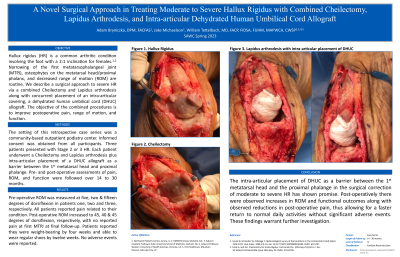
Introduction: Hallux rigidus (HR). is a common arthritic condition involving the foot with a 2:1 inclination for females.1,2 Narrowing of the first metatarsophalangeal joint (MTPJ), osteophytes on the metatarsal head/proximal phalanx, and decreased range of motion (ROM) are routine. We describe an approach to severe HR via a combined cheilectomy and Lapidus arthrodesis along with intra-articular placement of a dehydrated human umbilical cord (DHUC) allograft to improve postoperative pain, range of motion, and function.
Methods: The setting of this retrospective case series was a community-based outpatient podiatry center. Informed consent was obtained from all participants. Three patients presented with Stage 2 or 3 HR. Each patient underwent a Cheilectomy and Lapidus arthrodesis plus intra-articular placement of a DHUC allograft. Pre- and post-operative assessments of pain, ROM, and function were followed over 14 to 30 months.
Results: Pre-operative ROM was measured at five, two & fifteen degrees of dorsiflexion in patients one, two, and three respectively. All patients reported pain related to their condition. Post-operative ROM increased to 45, 40 & 45 degrees of dorsiflexion, respectively, with no reported pain at first MTPJ at final follow-up. Patients reported they were weight-bearing by 4-weeks and able to wear regular shoes by 12-weeks. No adverse events were reported.
Discussion: The intra-articular placement of DHUC in the surgical correction of moderate to severe HR has shown promise with observed increases in ROM and functional outcomes while reducing post-operative pain allowing for a faster return to normal daily activities without significant adverse events. These findings warrant further investigation.

.png)