(CS-083) Prevention of Revision Amputation Surgery with the Use of Copper Dressings
Friday, April 28, 2023
7:15 PM - 8:30 PM East Coast USA Time
Gadi Borlow, Dr – assistant for MedCu company, Rambam Health Care Campus; Ithamar Cheyne, Mr – Student, Orthopedics, Rambam Health Care Campus
Introduction: Major leg Amputations have a notoriously high rate of complications and revision surgeries. Wound dehiscence, stump ischemia, skin tension, subcutaneous hematoma, pressure necrosis, and superficial or deep infections often lead to extended or repeat hospitalization and surgery. The copper dressing has a well-known antimicrobial effect as well as angiogenesis and granulation tissue formation, enabling autolytic debridement and epithelization. We describe 4 cases in which planned revision surgery was avoided with copper dressings.
Methods: Diabetic patients were treated at the department of orthopedics in Rambam Health Care Campus in Haifa, Israel. Three patients had a transtibial amputation and one transfemoral. The complication etiology was pressure necrosis, stump ischemia, dehiscence due to tension of the sutures, and late dehiscence and necrosis from uncertain etiology. Bilayer active copper dressing was applied to the deep parts of the wound, and an adhesive copper layer was applied on top for the chemical and mechanical effect (reducing tension from the wound edges). Dressings were changed once or twice weekly.
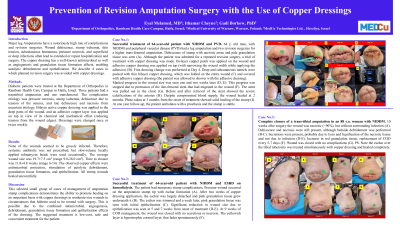
Results: None of the wounds seemed to be grossly infected. Therefore systemic antibiotic was not prescribed, but slow-release locally applied tobramycin beads were used occasionally. The average wound size was 19.7±7.5 cm2 (range 9.0-26.0 cm2). Time to closure was 11.8±4.8 weeks (range 6-14). The observed copper effects were antibacterial protection, stimulation of autolytic debridement, granulation tissue formation, and epithelization. All stump wounds healed uneventfully.
Discussion: This selected small group of amputees demonstrates the ability to promote healing on an outpatient basis with copper dressings in moderate-size wounds in cases that hitherto used to be treated with surgery. The suggested low-cost treatment is convenient for the patient and safe.

.png)