Introduction: Dry eschar is a solid denaturalized proteins that coalesced after skin and subcutaneous tissue necrosis. It can be regarded as a “biological dressing” since it confers protection from bacterial invasion. Nevertheless, the eschar shrinks and the interface between intact skin and the eschar becomes a portal of entry for bacteria. The dry eschar often becomes wet and infected, resulting in cellulitis or other form of spreading infection. Treatment typically includes debridement, means to promote granulation tissue formation and skin grafting. Copper dressings convey antibacterial protection and promotes angiogenesis, granulation tissue and debridement.
Methods: We present five cases of eschar wounds treatment with copper dressings* from the beginning to full closure in diabetic patients.
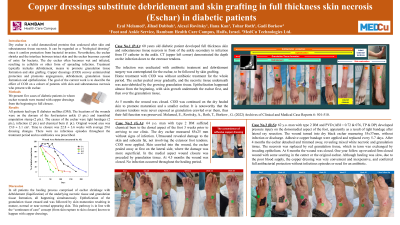
Results: The locations were on the dorsum of the foot anterior ankle (3 pts.) and transtibial amputation stump (2 pts.). The causes of the eschar were tight bandages (2 pts.), infection (2 pts.) and chemical burn (1 pt.). Original wound area was 15.0 ± 3.1 cm2. Time to closure was 22.8 ± 3.6 weeks with average 29.6 dressing changes. There were no infectious episodes and no antibiotics was prescribed.
Discussion: In all patients the healing process comprised of eschar shrinkage with debridement (liquification) of the underlying necrotic (fascial) tissue and granulation tissue formation, all happening simultaneously. Epithelization of the granulation tissue ensued and was followed by skin maturation resulting in mature, normal or near normal appearing skin. This pathway is in line with the “continuum of care” from skin rupture to skin closure concept observed with copper dressings.

.png)