(CS-092) Use of an Antimicrobial Synthetic Skin Substitute on an Advanced Age Laceration
Friday, April 28, 2023
7:15 PM - 8:30 PM East Coast USA Time
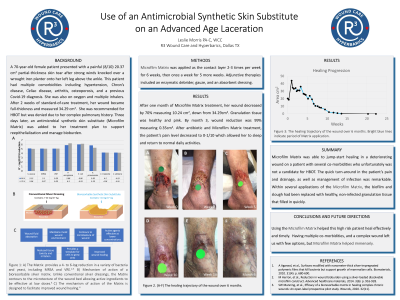
Introduction: A 70-year-old female patient presented with a painful (8/10) 20.37 cm2 partial-thickness skin tear after strong winds knocked over a wrought iron planter onto her left leg above the ankle. This patient had multiple comorbidities including hypertension, Chron’s disease, Celiac disease, arthritis, osteoporosis, and a previous Covid-19 diagnosis. She was also on oxygen and multiple inhalers. After 2 weeks of standard-of-care treatment, her wound was full-thickness and measured 34.29 cm2. She was recommended for HBOT but was denied due to her complex pulmonary history. Three days later, an antimicrobial synthetic skin substitute (Microfilm Matrix) was added to her treatment plan to support reepithelialization and manage bioburden.
Methods: Microfilm Matrix was applied as the contact layer 2-3 times per week for 6 weeks, then once a week for 5 more weeks. Adjunctive therapies included an enzymatic debrider, gauze, and an absorbent dressing.
Results: After one month of Microfilm Matrix treatment, her wound decreased by 70% measuring 10.24 cm2, down from 34.29cm2. Granulation tissue was healthy and pink. By month 3, wound reduction was 99% measuring 0.35cm2. After antibiotic and Microfilm Matrix treatment, the patient’s pain level decreased to 0-1/10 which allowed her to sleep and return to normal daily activities.
Discussion: Microfilm Matrix was able to jump-start healing in a deteriorating wound on a patient with several co-morbidities who unfortunately was not a candidate for HBOT. The quick turn-around in the patient’s pain and drainage, as well as management of infection was remarkable. Within several applications of Microfilm Matrix, the biofilm and slough had been replaced with healthy, non-infected granulation tissue that filled in quickly.

.png)