(CS-101) Negative Pressure Wound Therapy with Instillation for the Treatment of Surgical Site Infections
Friday, April 28, 2023
7:15 PM - 8:30 PM East Coast USA Time
Amit Rao, M.D. – Project Manager, Surgery, Northwell Health Comprehensive Wound Healing & Hyperbaric Center; Dorothy Michaels, M.S.N. – Nurse Practitioner, Wound Care, Nursing Education, Northwell Health, Plainview/Syosset Hospital; Asha Gallagher, D.P.T. – Director, Rehabilitation Services, Rehabilitation Services, Northwell Health, LIJ Valley Stream Hospital; Ernest Fabros, D.P.T. – Supervisor of Physical Therapy, Department of Physical Therapy, Northwell Health, LIJ Valley Stream Hospital; Luz Marina Pena, D.P.T. – Senior Physical Therapist, Department of Physical Therapy, Northwell Health, LIJ Valley Stream Hospital
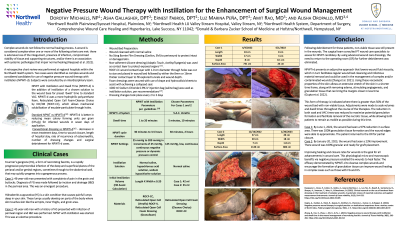
Introduction: The treatment of surgical site infections (SSI) with negative pressure wound therapy (NPWT) has become an important therapy in wound healing. Studies have demonstrated increased healing rates and greater success in complete closure with NPWT1. Recent advances in the NPWT technology have introduced the use of a contained instillation wash to periodically cleanse the wound while continuing vacuum pressurei.
iV.A.C. VERAFLO™ Therapy for NPWT with instillation, 3M
Methods: A retrospective chart review was performed at regional hospitals within the Northwell Health system. Two cases with use of NPWT with instillation were identified in complex wounds. Subjects were consulted by an interdisciplinary team and deemed appropriate for NPWT with instillation.
Results:
46-year-old manwith no known medical history presented to Emergency Department with complaints of pain in the groin and buttocks. Admission diagnosis of Fournier’s Gangrene was made, followed by extensive incision and drainage (I&D) in the perineal area. The patient was started on NPWT with illation. At the start of treatment, the subject's wound measured over 5,800cm3. After 4 weeks of treatment, the subject's wound measured 168m3. The wound was 100% granular tissue with moderate sanguineous discharge when instillation vac was stopped and replaced with standard NPWT.
42-year-old man with a history of hidradenitis suppurativa presented with infection of perineal region. The wound was deemed to be infected and I&D was performed. NPWT with instillation was started. Baseline wound measurement was 7980cm3 and noted to consist of 25% granular tissue. After 3 weeks of treatment, the subjects wound had converted to 100% granulation tissue and reduced in volume by 69%. The subject was discharged on standard NPWT.
Discussion: Improving healing and closure rates for wounds is the goal for all advancements in wound care. The promotion of granulation tissue after extensive I&D at areas of surgical site infection is necessary for healing to occur. The efficacy demonstrated by NPWT with instillation to cleanse complex wounds and encourage the formation of granulation tissue and can improve wound healing in difficult complex cases with infection.

.png)