(DLS-020) The Use of Mobile Multispectral Near-Infrared Spectroscopy to Detect Revascularization of the Microcirculation of Individuals with Venous Leg Ulcers post-treatment: A Case Series
Friday, April 28, 2023
7:15 PM - 8:30 PM East Coast USA Time
Amit Rao, M.D. – Project Manager, Surgery, Northwell Health; Joanne Eisenger, P.A. – Director, Clinical Care, Surgery, Northwell Health; Marisa Ranire-Maguire, M.D. – Attending Physician, Surgery, Northwell Health; Christina del Pin, M.D. – Attending Physician, Surgery, Northwell Health; Kane Genser, M.D. – Fellow, Wound Care, Surgery, Northwell Health; Gregg Landis, M.D. – Vice Chairperson, Vascular, Surgery, Northwell Health
Introduction: Chronic venous insufficiency (CVI) can lead to complications including venous leg ulcers (VLU). Multispectral near-infrared spectroscopy (NIRS) potentially provides a tool to assess microcirculation as it provides spatial information on the tissue oxygenation of the microvasculature. The objective of this study is to investigate the utility of NIRS in detecting the revascularization of the microcirculation in individuals with CVI and venous leg ulcers after receiving an invasive treatment.
Methods: This study observed patients undergoing an invasive procedure to treat their CVI and venous leg ulcer. Multispectral near infrared images of the lower extremity were collected prior to intervention, and afterwards. An FDA-cleared hand-held mobile multispectral near infrared imaging device* was used to measure temperature and tissue oximetry (StO2). Individuals with chronic venous insufficiency leading to stasis ulcers were selected for this case series. Images were acquired from multiple anatomic locations including the foot (dorsum and plantar), medial and lateral leg, and proximal leg. Demographic, medical history, arterial and venous studies performed prior to procedure are reported.
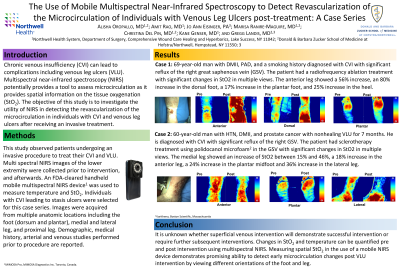
Results: Case 1: 69-year-old man with Type II diabetes, peripheral arterial disease, and a smoking history. He is diagnosed with chronic venous insufficiency with significant reflux of the right great saphenous vein. The patient had a radiofrequency ablation treatment with significant changes in StO2 in multiple views. The anterior leg showed a 56% increase, an 80% increase in the dorsal foot, a 17% increase in the plantar foot, and 25% increase in the heel.
Case 2: 60-year-old man with hypertension, Type II diabetes, and prostate cancer with nonhealing VLU for 7 months. He is diagnosed with chronic venous insufficiency with significant reflux of the right great saphenous vein. The patient had sclerotherapy treatment using polidocanol microfoam1 in the GSV with significant changes in StO2 in multiple views. The medial leg showed an increase of StO2 between 15% and 46%, a 18% increase in the anterior leg , a 24% increase in the plantar midfoot and 36% increase in the lateral leg.
1Varithena, Boston Scientific
Discussion: It is unknown whether superficial venous intervention will demonstrate successful intervention or require further subsequent interventions. Changes in tissue oximetry and temperature can be quantified pre and post intervention using multispectral NIRS. Measuring spatial tissue oximetry in the use of a mobile NIRS device demonstrates promising ability to detect early microcirculation changes post VLU intervention by viewing different orientations of the foot and leg.

.png)