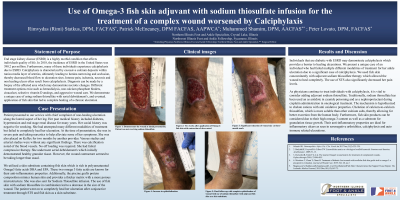
Introduction: End-stage kidney disease (ESRD) is a highly morbid condition that affects individuals' quality of life. In 2018, the incidence of ESRD in the United States was 390.2 per million1. Furthermore, many of these individuals experience calciphylaxis due to ESRD. Calciphylaxis is characterized by excessive calcium deposits within the tunica media layer of arteries, ultimately leading to luminal narrowing and occlusion, thereby decreasing blood flow to ulceration sites. A biopsy can diagnose the affected area, which may demonstrate necrotic changes.
Methods: The patient presented to our service with the chief complaint of non-healing ulceration along the lateral aspect of her leg. She had attempted many different treatment modalities but failed to heal her ulceration completely. At the time of presentation, she was in severe pain and taking narcotics to help alleviate some of her symptoms. Venous studies and arterial studies were without any significant findings. We utilized a skin substitute containing fish skin, with a robust Omega-3 component that may have an additive anti-inflammatory effect. She was also sent for Sodium Thiosulfate (STS) infusion. Using fish skin with STS in combination led to a decrease in wound size. The patient went on to completely heal her ulceration after conjunctive treatment through STS and fish skin as a skin substitute.
Results: Individuals that are diabetic with ESRD may demonstrate calciphylaxis, which provides a barrier to healing ulcerations. We present a unique case of an individual who had failed multiple treatment modalities for her ankle ulceration due to significant calciphylaxis. We used fish skin concomitantly with adjuvant sodium thiosulfate therapy, which allowed the wound to heal completely. The use of STS also significantly decreased her pain levels.
Discussion: As physicians continue to treat individuals with calciphylaxis, it is vital to consider adding adjuvant sodium thiosulfate. Furthermore, fish skin products can be considered and have proven to augment acute and chronic wound healing2,3. Like other published data, our patient subjectively reported a significant pain reduction following the application of the fish skin4. More extensive studies should investigate the use of fish skin for healing ulcerations and its analgesic effects in patients with ESRD and subsequent calciphylaxis.

.png)