(CS-122) Definitive Wound Closure of a Large scalp Mohs defect with exposed cranium in an irradiated field utilizing a fish skin xenograft
Friday, April 28, 2023
7:15 PM - 8:30 PM East Coast USA Time
Introduction: Moh's micrographic surgery is a tissue-sparing technique used to treat nonmelanoma skin cancers. Reconstruction of soft tissue defects after Moh's surgery can be a substantial challenge Factors that exacerbate the clinical challenge include gender, modifiable risk factors, diabetes mellitus, size and severity of the defects, and the complexity of the reconstructive modality1. In wounds with the exposed underlying bone, there are limited reconstructive options. The closure could be further complicated if the area received prior radiation therapy due to insufficient blood supply, fibrosis, and attenuated cellular function2. To this end, advanced biologics, including a fish skin graft, are often warranted. This investigation aimed to determine the clinical efficacy of fish skin in this subset of challenging patients.
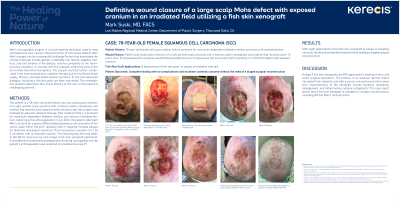
Methods: The patient is a 78-year-old white female who was status post resection of a right parietal scalp sarcoma with a titanium plate cranioplasty and rotation flap reconstruction approximately ten years ago. Her surgery was followed by adjuvant radiation therapy. Past medical history is pertinent for noninsulin-dependent diabetes mellitus and venous thromboembolism, requiring active anticoagulation. In July 2022, the patient underwent Moh's excision for a poorly differentiated squamous cell carcinoma of her vertex scalp within the prior radiation field. It required multiple passes for definitive oncological clearance. The final excision resulted in a 7 by 5 cm defect with an exposed cranium. The following day, she was taken to the OR for bone burring and omega-3 fish skin xenograft placement. A nonadherent compressive postoperative dressing was applied, and the patient's anticoagulation was restarted on postoperative day #1.
Results: After eight applications of the fish skin xenograft at weekly or biweekly intervals, the wound completely healed without needing a staged surgical reconstruction.
Discussion: Omega 3 fish skin xenografts are FDA approved for treating chronic and acute surgical wounds3,4. The product is an acellular dermal matrix harvested from Icelandic cod with a porous microstructure like human skin. Characteristics of the xenograft include bacterial resistance, angiogenesis, and inflammatory cytokine mitigation5. This case report shows that a fish skin xenograft is suitable for complex wound closure, including difficult Moh's reconstruction.

.png)