(CS-135) Surgical Site Infection (SSI) identified 5 days prior to visible symptoms using Long Wave Infrared Thermography (LWIT)
Friday, April 28, 2023
7:15 PM - 8:30 PM East Coast USA Time
Paige Pierce MD, MD – Hospitalist, Medical, Bloomington Medical
Introduction: Surgical Site Infection (SSI) impacts patient care outcomes and cost; SSI is a cause of morbidity, prolonged hospitalization, and death. Long Wave Infrared Thermography (LWIT) can reveal quantitative assessment data of the pathophysiologic healing process, such as inflammation and infection.
Methods: Long Wave Infrared Thermography (LWIT)* was added to the daily assessment; LWIT was utilized at the bedside and at home to image the incision site pre-operatively and then daily for 29 days. The images were analyzed for thermal temperature changes. During the inflammatory phase of healing, the thermal image is expected to show early diffuse inflammation resolving by the 4th post-op day (POD)2.
Results: DV is a 55-year-old male with a medical history of hypertension, gout, obesity, splenectomy, and vertebral stent. DV underwent a Quadruple Coronary Artery Bypass Graft (graft site, left brachial artery) on 11/26.
The Left arm incision was assessed as follows:
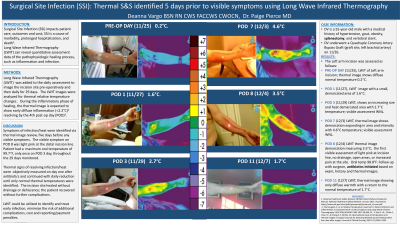
Pre-op day (11/25), LWIT of Left arm incision diffused normal temperature 0.2°C.
(POD) 1 (11/27), LWIT images with a small, demarcated area of 1.6°C.
POD 3 (11/29) LWIT presented a larger demarcated warm area with 2.7°C temperature, visible WNL.
POD 7 (12/3) LWIT shows demarcation expanding in area and intensity with 4.6°C temperature; visible assessment WNL.
POD 8 (12/4) LWIT demarcation measuring 3.5°C; oral temp 98.8°F, visibly the first assessment of light pink at incision line, no drainage, open areas, or increased pain at the site. Returned to office, antibiotics initiated.
POD 11 (12/7) LWIT showing diffuse only with a return to the normal temperature of 1.7°C.
Discussion: Symptoms of infection were identified via LWIT thermal image reviews, five days before any visible symptoms, with a maximum oral temperature at < 99.7°F throughout the 29 days. Thermal signs of decreasing infection/heat were objectively measured on day one after antibiotics and continued with daily reduction until only normal temperatures were identified.
The incision site healed without drainage or dehiscence; the patient recovered without further complications. LWIT could be utilized to identify and treat early infections, perhaps minimizing the duration of antibiotics and the risk of other complications.

.png)